AI built on your data. Not on someone else's.
Institution-specific models, built-in agents, and AI tools, all grounded in your institution's own data and priorities — so teams act with confidence, and you can see what the AI did.
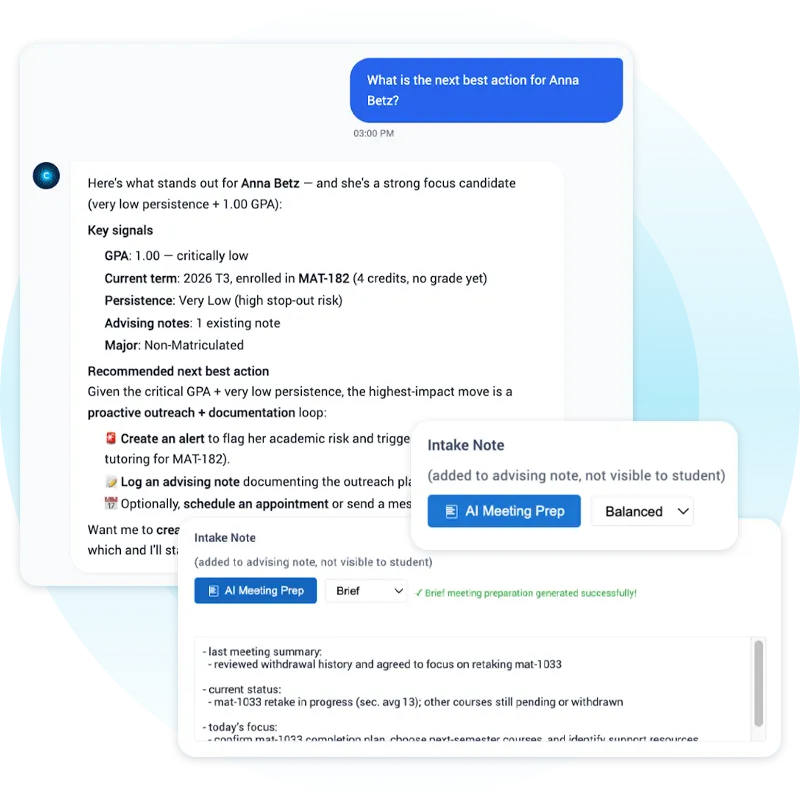
Forty-five seconds: an agent writes the advising note, and the advisor keeps the decision.
Fifteen years of AI in higher education. Several generations of it.
Civitas Learning has built AI for colleges and universities since 2011 — long before agents were on every vendor's slide. Each generation of the technology changed what the AI could do. What it learned from, and how it is judged, stayed the same: your institution's own data, and measured outcomes.
Predict
Institution-specific predictive models, trained on each college’s own student history. Where Civitas started in 2011, and still the foundation.
Embed
AI inside advising, planning, and scheduling, so a prediction reaches the person who can act on it, the same day.
Act
Generative and agentic AI that drafts the note, builds the student list, and runs the automation — on the same institution-specific models.
Lessons a new AI vendor has not had time to learn yet.
Four capabilities. One institution-specific model behind all of them.
Chats, plans, builds, acts — across leadership, enrollment, student success, academics, IR/IE, and career services.
AI agents and assistants
Prioritize outreach, prep meetings with context and next steps, explore data, and generate reports — inside the workflow, not beside it.
Build your own agents
Automate repetitive work with no code. Share agents across teams. Scale execution without adding staff.
Institution-specific models
Persistence, completion, and engagement predictions. Course demand forecasts. Program and intervention outcome measurement. Trained on your history, never on other institutions' data.
Built-in AI tools
Prepare for student interactions, summarize conversations and notes, and get context-based next steps.
Say what you want done. The assistant finds the students, then builds the automation.
An advisor types one sentence: target low-GPA students weekly so they meet with me. The assistant pulls the real list first — every student with a GPA from 0 to 2.0 — so the automation rests on data before anything is sent. One click saves them as a group or turns the request into a weekly skill.
- 1You ask in plain language: target low-GPA students weekly so they meet with me.
- 2The assistant grounds it in real data first: 12,744 students with a GPA from 0 to 2.0.
- 3You see exactly who is on the list, with major and persistence, before anything is sent.
- 4You choose the action: save them as a group, or create a skill that repeats every week.
Every action is logged and attributed. The assistant proposes; your staff decide.
For the advisor
Monday's list is built before the advisor logs in: who to call, why, and what to say. The note is drafted after the meeting.
For the cabinet
Ask in plain language — which programs lost the most students after gateway math? — and get the answer with the model's confidence attached.
For IT
No new system of record. Agents read from and write back to Banner, Canvas, Slate, and the rest through your existing integrations.
Questions institutions ask about AI in higher education
Short answers, in the words a cabinet uses. For anything not here, ask us directly.
What is agentic AI, and how is it different from a chatbot?
Agentic AI can complete multi-step work on a team's behalf, such as building a student group, drafting an automation, or generating a report, rather than only answering questions in a single conversation. Civitas Learning's agentic AI is grounded in your institution's own data, so its actions reflect your students and your context.
Why is Civitas Learning AI different from other general-purpose AI solutions?
Civitas Learning AI is grounded in your institution's own data, context, and historical outcomes. Instead of providing generic answers or recommendations based on national averages, it connects AI to the intelligence and workflows that matter to your institution.
How long has Civitas Learning been building AI for higher education?
Since 2011 — fifteen years, through several generations of AI: institution-specific predictive models first, then AI embedded in advising, planning, and scheduling, and now generative and agentic AI on the same models. The lessons carry forward: retrain every term, keep a person in the decision, and measure every initiative against a comparison group.
Is AI built into the Institutional Impact Platform?
Yes. AI capabilities are built into the platform, so teams can access intelligence and assistance where they already work rather than managing separate AI tools.
Do I need to purchase individual AI agents or pay for tokens?
No. Civitas Learning AI does not use a token-based model or require you to purchase individual agents. You can build and use as many agents as you need, all integrated directly into the platform, with no separate agent platform to buy. How pricing works →
Is Civitas Learning's AI trained on data from other institutions?
No. Every recommendation is built on your institution's own unified data and predictive models, not on benchmarks pooled from other schools.
Do our teams need to know how to code to build an agent or automation?
No. Teams describe the challenge they are trying to solve in plain language, and the platform builds the automation. No scripting or technical setup is required.
How does Civitas Learning keep AI transparent and under our team's control?
AI assistants and automations surface recommendations and next steps, and your teams make the final decisions. Every action is logged and attributed, so the institution can review what the AI did on its behalf.
Does adopting your AI require a new implementation project?
No. Agentic AI is built into the platform your teams already use, so there is no separate system to implement or maintain.
How do we get started?
Schedule a conversation with our team. We will learn about your goals and help you identify which AI assistants and capabilities fit your institution first. Book a demo →
Bring your questions. Leave with an estimate you can defend.
A 45-minute working session: we start from your public IPEDS figures, show what the platform found at institutions like yours, and size the outcome — before anyone touches your data.