Know which programs pay off for graduates. Before the Department of Education tells you.
The career module follows every graduate for years — jobs, salaries, promotions, and where they work — not a first-destination survey, and ties it to career readiness, persistence, and graduation by program. Deans see the earnings test coming while there is time to act.
The rule has changed. Graduate earnings now decide loan eligibility.
Under the Department of Education's earnings accountability framework, finalized in 2026 and effective July 2027, every Title IV-eligible degree program is measured against what its graduates earn. A program whose graduates repeatedly earn less than working adults with only a high school diploma loses federal loan eligibility. The verdict arrives years after those students enrolled, when the only options are closing the program or absorbing the loss. The career module gives deans and provosts the Department's view, program by program, years earlier.
A diagnostic, not an autopsy
Employment data arrives after graduation, too late to act. The career readiness index tracks each student's progress toward a career in real time — internships, experiential learning, career programming, mentorship, and résumé work — beside persistence and grades. A degree plan for career readiness. A student with a 3.4 GPA can still be unready for the job market; the index shows it sophomore year, not in a wage record four years after commencement.
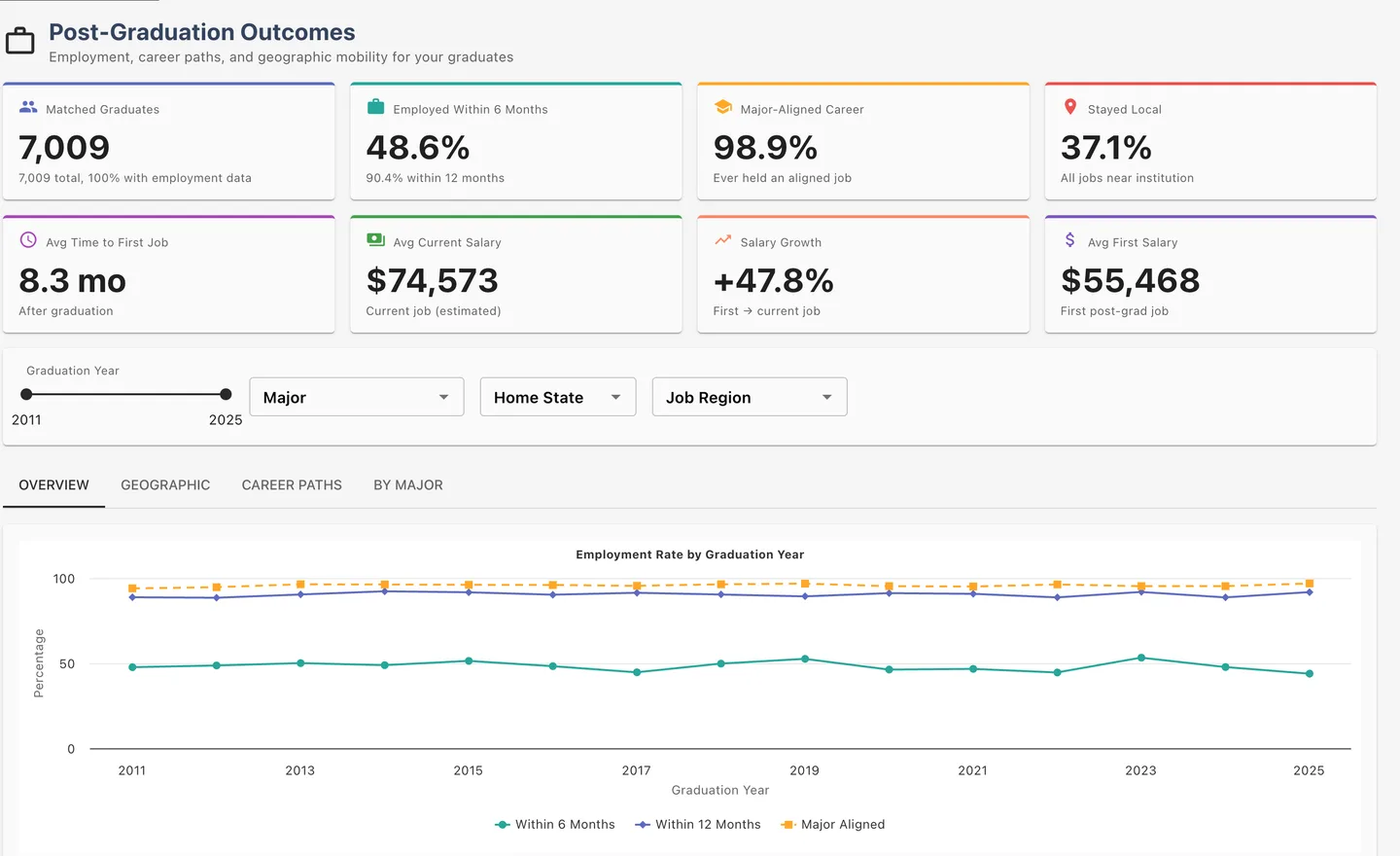
Every student and every graduate, over years. Not a first-destination survey.
A first-destination survey reaches the graduates who answer, six months out, once. The career module covers the whole student body while enrolled and every alumni cohort after, year over year, by program and student group — the same longitudinal view the Department uses for the earnings test. It is the only way to see whether a 2026 curriculum change moved the earnings of the class of 2030: one record per student, first term to fifth year out.
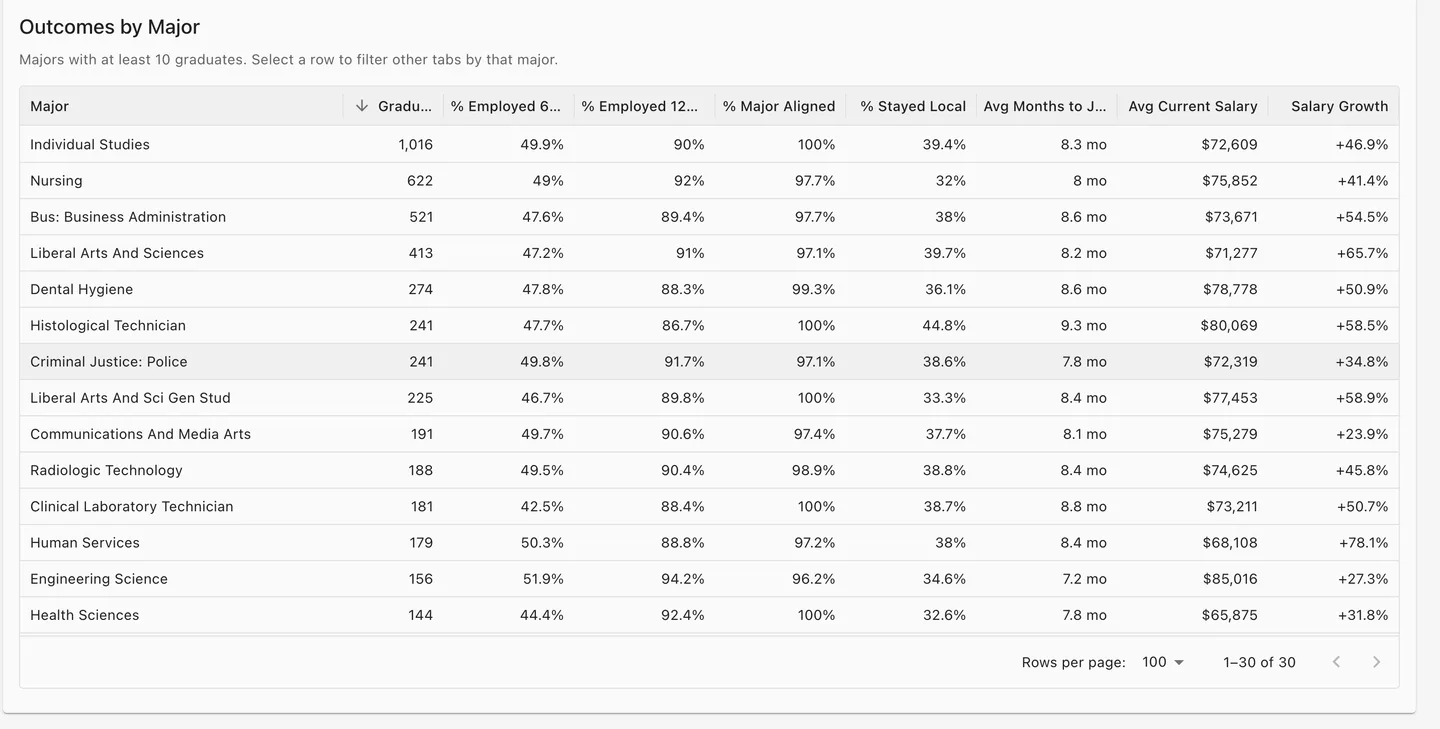
Every graduate’s jobs and salaries, four years out and beyond
The federal earnings test reads what a program’s graduates earn four years after they finish. The career module matches every graduate to employment data and follows each alumni cohort year over year, so the four-year picture is already built when the Department asks — by program, graduation year, and student group.
- Employment: employed within 6 and 12 months, time to first job, and whether the job fits the major
- Salary: first salary, current salary, and salary growth for each graduate, rolled up by program
- Career paths: every job held, promotions, company changes, top first employers, and top industries
- Place: the states graduates work in, and whether they stay local, leave, or come back
- Four years out and beyond: one record per student from first term to fifth year out, so year-four earnings sit beside persistence and graduation
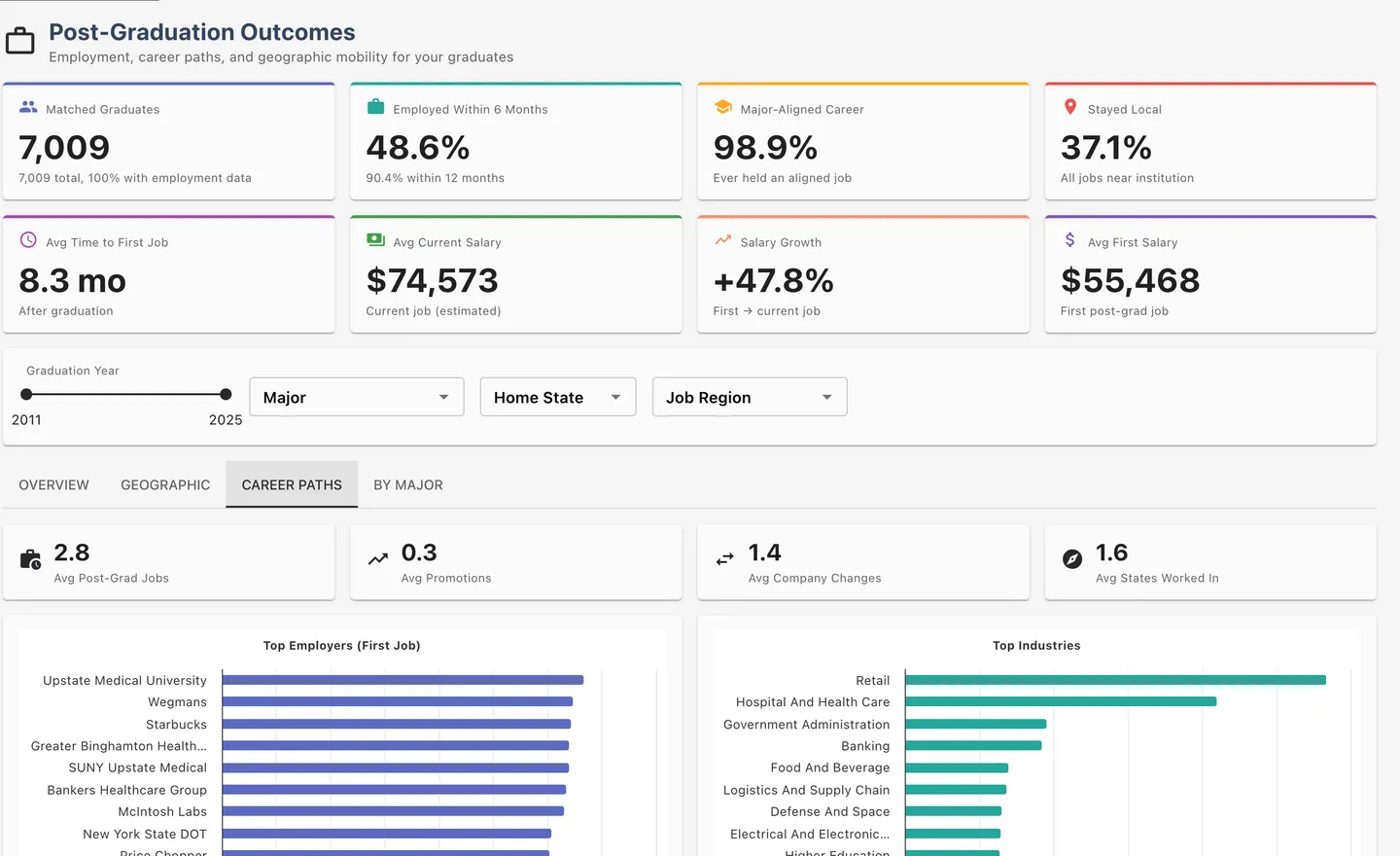
A scoreboard for every dean
Each degree program gets one page: enrollment, engagement, persistence, graduation, career readiness, and — where state wage data allows — graduate earnings against the federal threshold. Deans see which programs are clear, which are close, and which need a curriculum change, an internship pipeline, or a hard conversation. The same page answers the accreditor, the state, and the board.
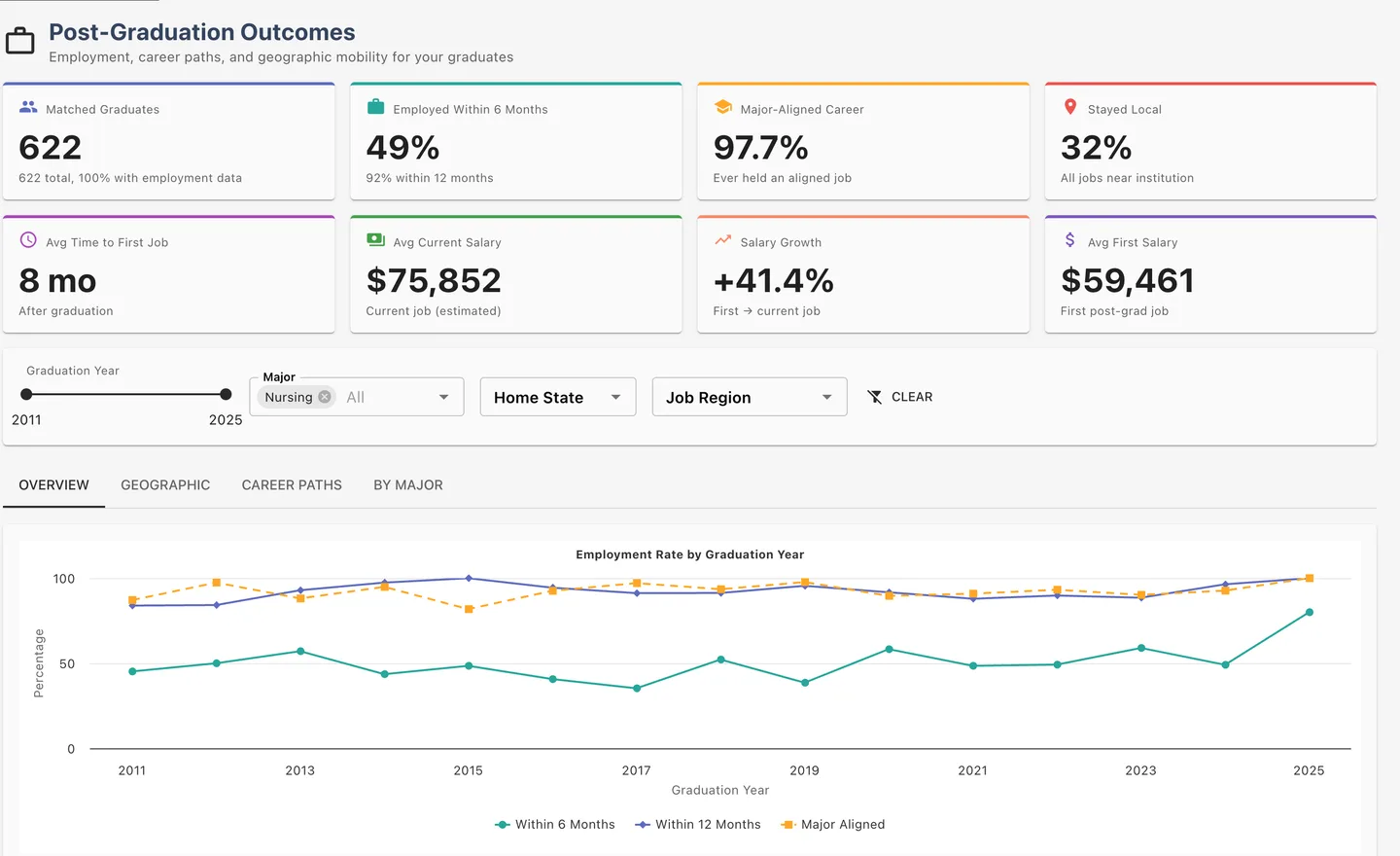
Find the students who are not career ready, while there is time
Dynamic student groups update as data changes. A business junior with no internship, no career center visit, and a falling persistence score is on a list by Monday. Career services, the advisor, and the department share the list and the plan, and outreach goes only to students who need it.
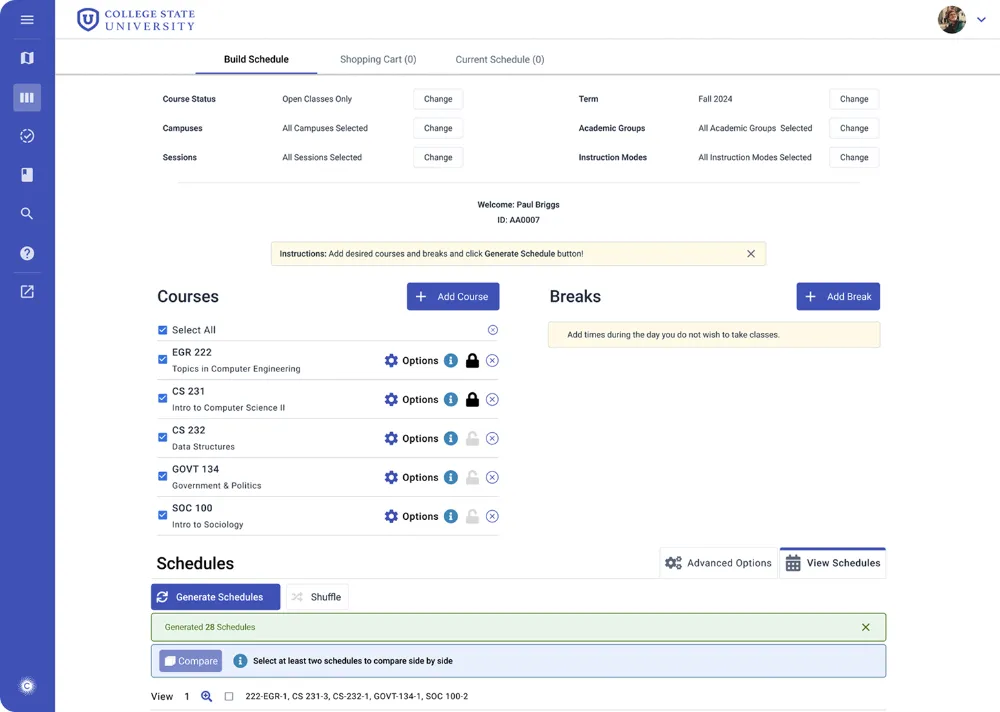
Measure which career programs move persistence and earnings
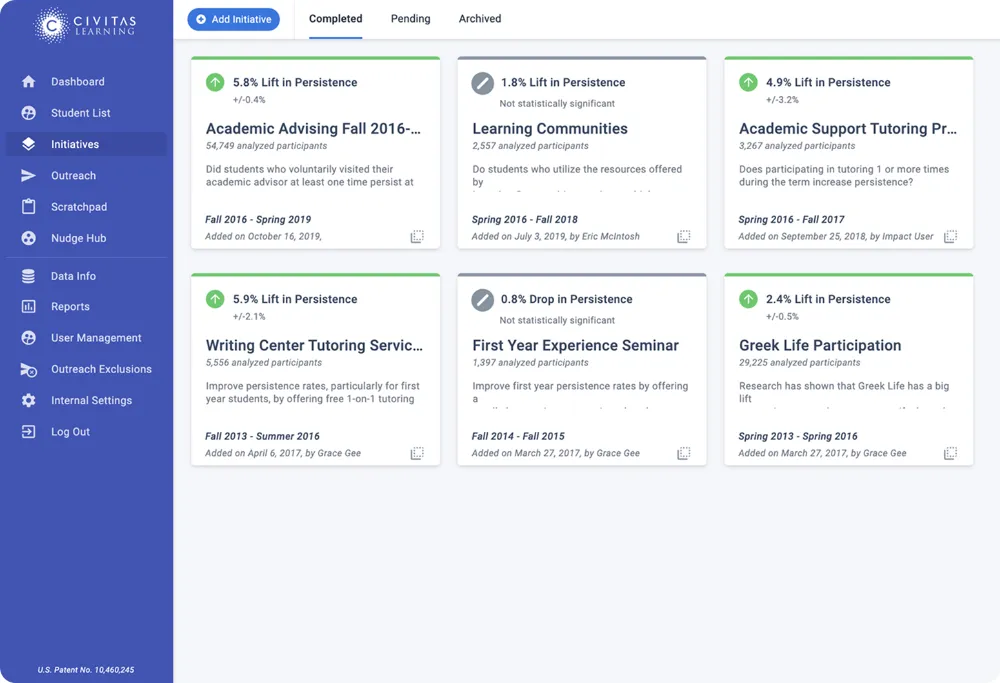
Institutions run internships, alumni mentoring, applied learning, and career coaching, but rarely know which work for whom. Each program is measured against a matched comparison group on persistence, completion, and later earnings, by student group. UT San Antonio found statistically significant retention gains for students who met career consultants or had mentors. The budget follows the evidence.
What the career module shows
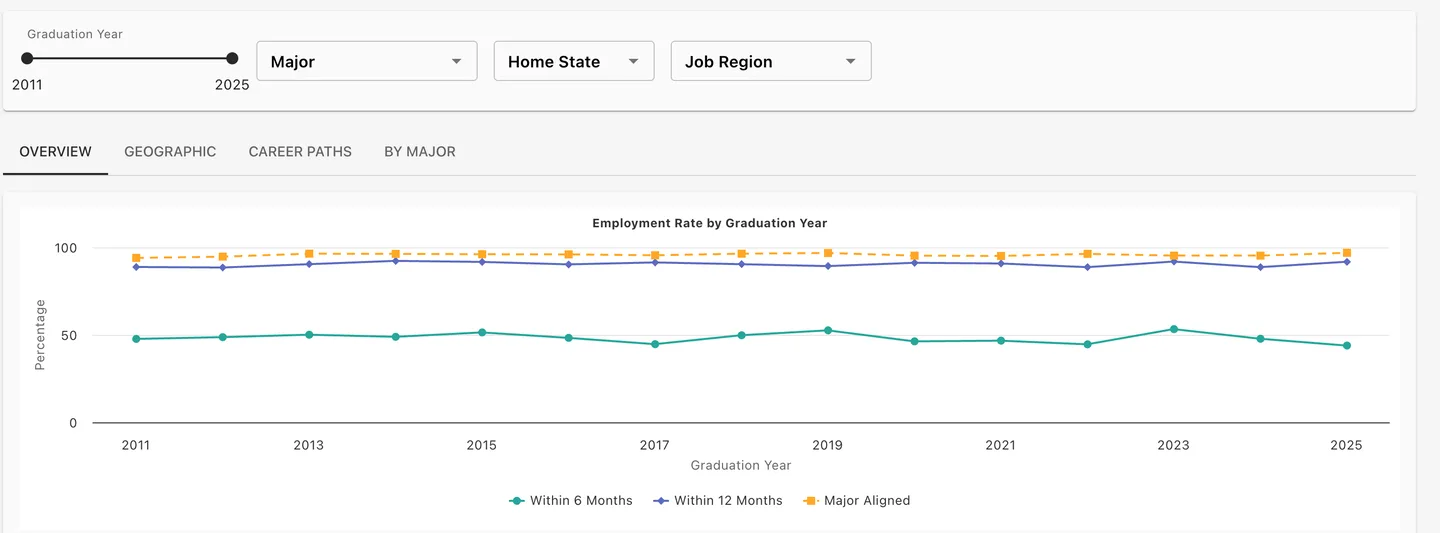
Overview
Every graduate matched to employment data: employed at 6 and 12 months, major-aligned career, time to first job, first and current salary, and salary growth, by graduation year.
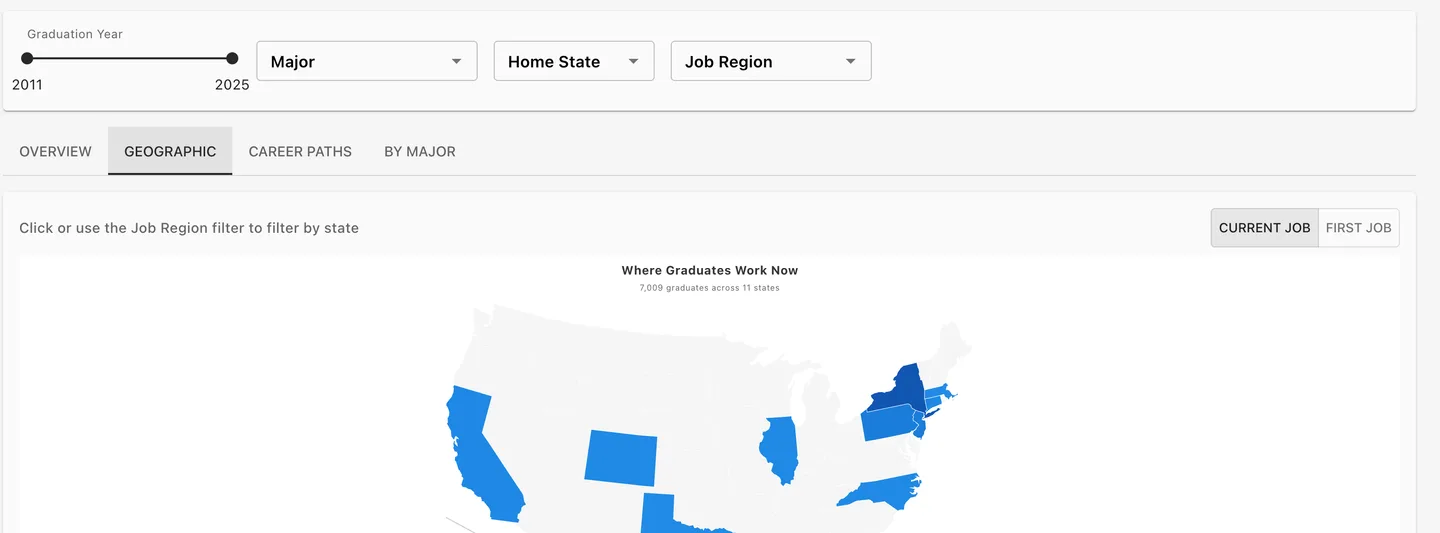
Geographic
Where graduates work now and first worked, by state, with community retention: always local, left and returned, stayed then left, never local.
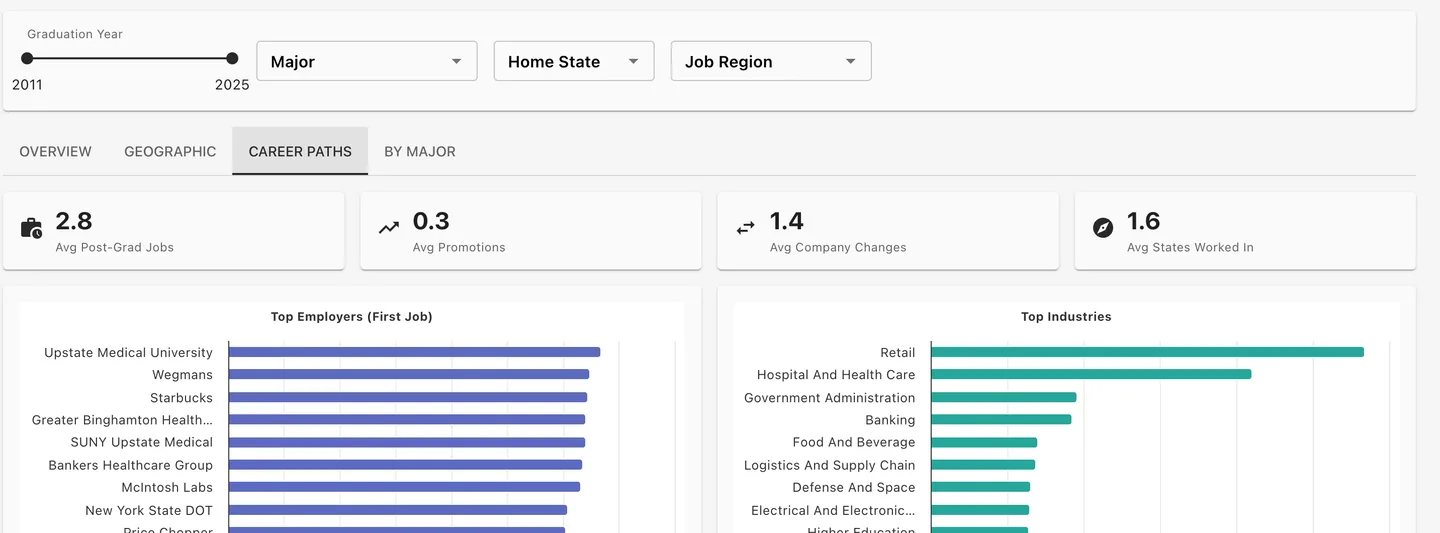
Career paths
Jobs, promotions, company changes, and states worked per graduate, with top first employers and industries.
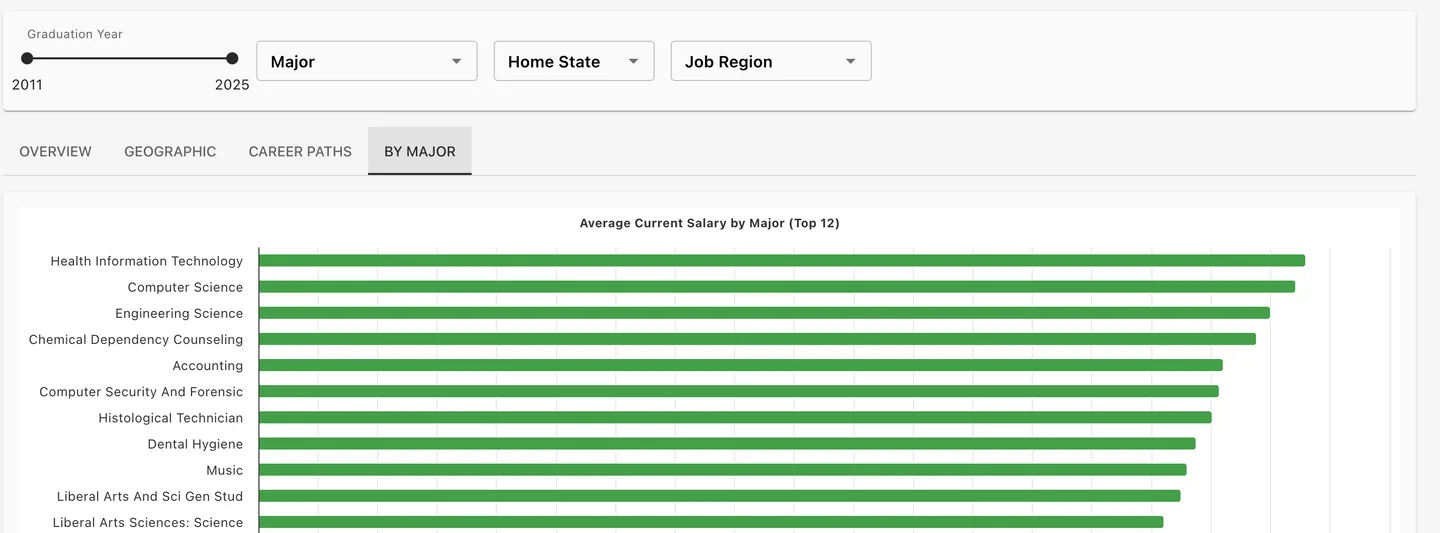
By major
Average current salary by major, and outcomes for every program with at least ten graduates. Select a program to filter every view.
For Deans & Provosts
Program accountability without waiting for the Department.
- Graduate earnings by program against the federal threshold, years before the determination
- Curriculum and experiential-learning changes measured on persistence and earnings
- One page per program for the board, the accreditor, and the state
For Career Services
From opt-in to built-in.
- A career readiness index for every student, refreshed as engagement data changes
- Target internship and career outreach to the students most likely to benefit
- Prove which programs move outcomes, and defend the budget with a number
For Institutional Research
The earnings test on your own data.
- Every student and every alumni cohort in one longitudinal record: persistence, graduation, career engagement, and earnings
- Comparison-group measurement of every career initiative, by student group
- Federal, state, and accreditor reporting from the same numbers
Every office gets a number. This page is one of six.
Enrollment, engagement, persistence, graduation, and career outcomes, each measured against a comparison group. The same data, the same model, one ledger for the cabinet, the board, and the Department of Education.
Civitas works under FERPA as a school official you designate, with a published data sharing agreement and platform specifications. Accessibility conformance reports are available on request. Security and privacy → Trust Center →
“It's already after the fact that we look at it, more of an autopsy rather than a diagnostic tool that's happening in real time.”Mario VelaAssistant Vice Provost of Career Engaged Learning, University of Texas at San Antonio
Questions institutions ask about career outcomes & accountability
Short answers, in the words a cabinet uses. For anything not here, ask us directly.
What are the new Department of Education earnings rules?
The Department of Education's earnings accountability framework, finalized in 2026 and effective July 2027, compares program graduates' earnings to a benchmark. Programs that fall short can lose federal student aid. Institutions that wait for the determination will react to a number they could have seen years earlier.
How do we know which programs are at risk?
Measure graduate earnings by program against the federal threshold now, on your own data. The career module reports earnings and outcomes by program, so a provost sees which programs are close to the line.
Do you only track first destination?
No. Civitas maps the whole student body and alumni population over years, not a survey six months after commencement, so you can see whether graduates stay above the threshold long after they leave.
Can we see graduate jobs and salaries four years after graduation?
Yes. The career module matches every graduate to employment data and follows each cohort year over year: employment at 6 and 12 months, time to first job, major alignment, first and current salary, salary growth, jobs held, promotions, and where graduates work — by program, graduation year, and student group. That is the four-year window the federal earnings test reads.
How is this different from a first-destination survey?
A survey captures one moment from a self-selected sample; longitudinal data covers the whole population over time. Response bias is why first-destination numbers look better than the cohort really did.
Does career engagement affect persistence?
Yes. In the 2026 Student Success Impact Report, career engagement was associated with a 7 percent persistence lift at two-year institutions and 2 percent at four-year institutions, and the platform shows which experiences drove it for whom.
Which systems does the career module read from?
Handshake, Canvas, Banner, and Salesforce, among others, so internships, mentoring, and career coaching join the same record as academic progress.
Who uses this at an institution?
Deans and provosts for program decisions, career services for where to invest, and institutional research for accreditation, state reporting, and the federal filing.
Bring your questions. Leave with an estimate you can defend.
A 45-minute working session: we start from your public IPEDS figures, show what the platform found at institutions like yours, and size the outcome — before anyone touches your data.