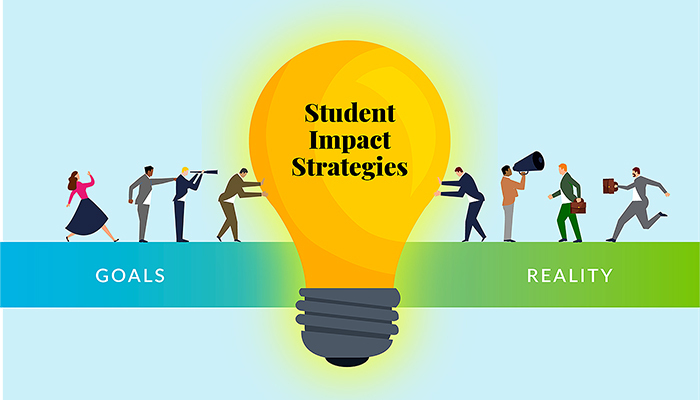
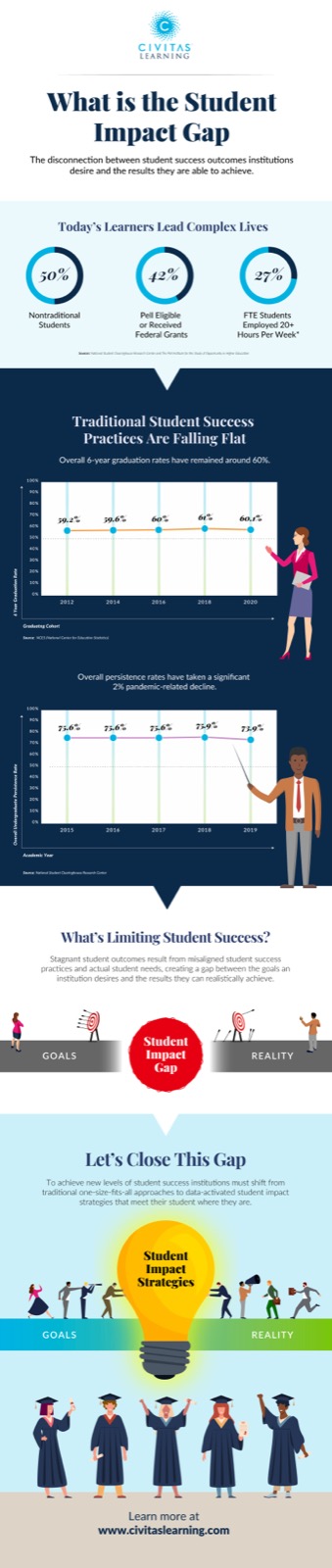
Across higher education, many institutions are tackling today’s challenges with yesterday’s solutions. These often one-size-fits-all approaches cause a disconnect between the student success outcomes institutions desire and the results institutions can actually achieve. At Civitas Learning, we call this phenomenon The Student Impact Gap.
What Causes the Student Impact Gap?
Even before the pandemic, colleges and universities faced serious challenges to their traditional way of doing business, such as a decline in the perceived value of higher education, a shrinking number of high school graduates, a diversifying undergraduate student population, more alternatives to postsecondary education, and shifting labor market demands. These challenges lead to college enrollment declines, stagnating student retention and completion rates, increasing financial instability, and even closure.
On top of that, the pandemic amplifies existing pressures and adds new ones. Students continue to navigate uncertainty, health concerns, isolation from family and friends, and economic instability. Meanwhile, institutions reopen physical campuses, invest in holistic student support, and build significant testing and vaccination operations. For some institutions, the pandemic exacerbates the existing enrollment crunch and student retention decline, leading to even more lost revenue as expenses continue to increase – further threatening institutional financial health.
“Status quo,” one-size-fits-all approaches where approximations are good enough, information is siloed, and data are backward-looking aren’t adequate. Traditional methods rooted in historical data, general best practices, and set-and-forget programs increase costs while diluting student success outcomes.
The traditional approach is no longer keeping up with the complex needs of today’s diverse student population. Nearly 50% of learners are busy adults over the age of 25 who have at least one family or work commitment they’re managing alongside their education. Plus, these ever-evolving challenges outpace available resources and operating budgets.
Let’s Close the Student Impact Gap
This diversity of needs makes it imperative to implement student success strategies that actually work for specific students at specific institutions. The consequence of not aligning institutional practice with student needs is a continuation of this disconnection between desired student outcomes an institution needs to achieve and the results they can achieve.
To close this gap, institutions must predict risks for every student and student group, diagnose the underlying cause of risk factors and prescribe precise interventions that address the needs of their students right now. Failure to do so will create a ripple effect of negative consequences resulting in lost generations of students and an existential crisis for institutions.

Related
How Lorain County Community College Uses Analytics to Reach Persistence and Graduation Goals
Find out how Lorain County Community College delivers holistic student success initiatives that boost retention and completion.Read Success Story
5 Questions to Ask Before Buying an AI Agent for Higher Ed
Before buying an AI agent, ask what information it's acting on, not just what it can do. Learn five questions every higher ed leader should ask before making a decision.
Read →blog postInaction Has a Price: The Hidden Cost of Delayed Student Success Investments
Every semester of delay has a cost. Learn how waiting on student success technology impacts students, advisor capacity, and institutional revenue.
Read →blog postBeyond Student Success: Evaluating Higher Ed Software, Vendors, & Institutional Fit
Features are easy to evaluate. Coordination is harder — and far more important to long-term institutional outcomes.
Read →Bring your questions. Leave with an estimate you can defend.
A 45-minute working session: we start from your public IPEDS figures, show what the platform found at institutions like yours, and size the outcome — before anyone touches your data.